
Most agency proposals look the same on paper. The differences show up in month three: who is actually running your account, whether the tracking was ever right, and who owns the data when you leave. Here is how to check all of that before you sign.

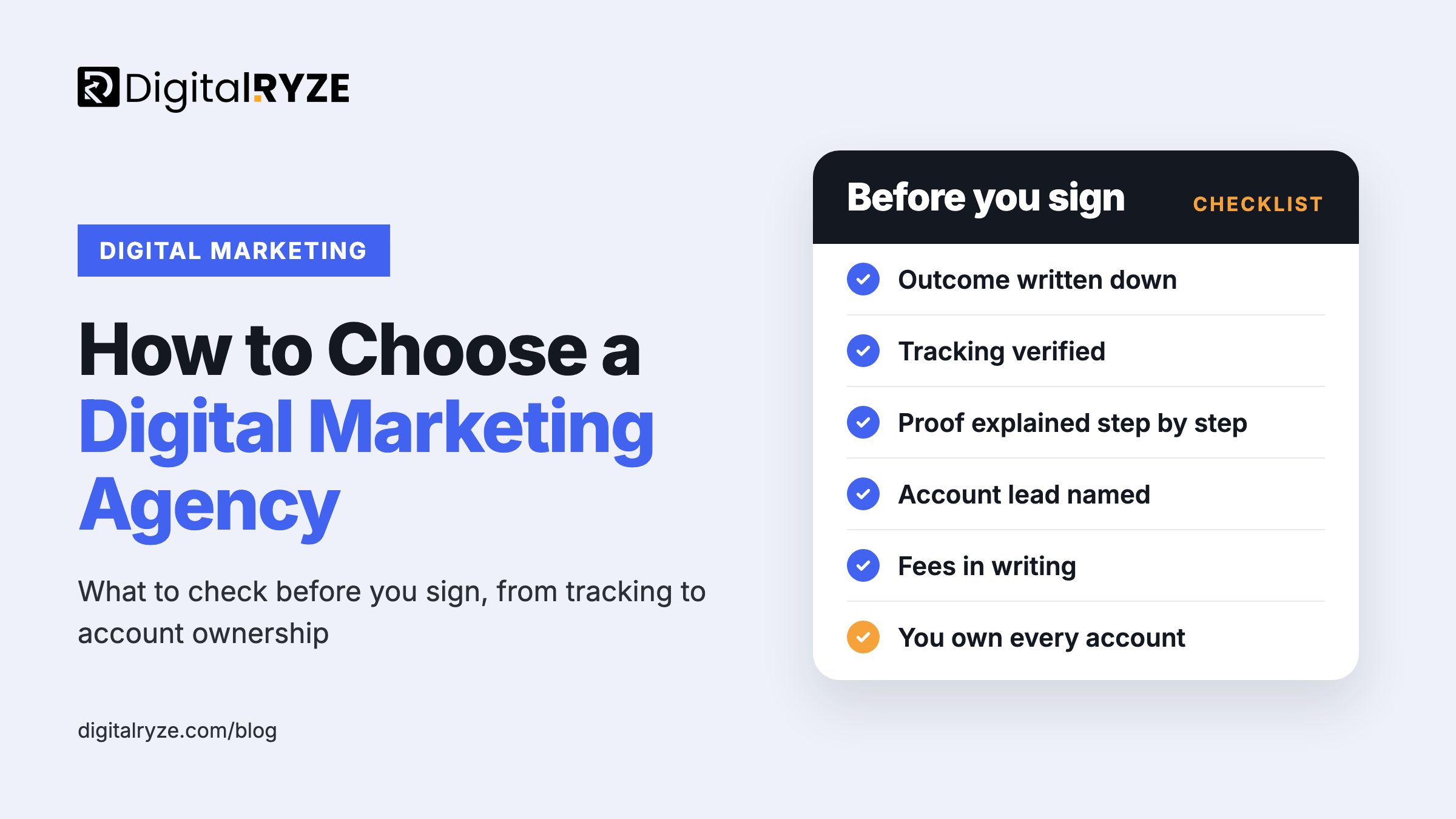
Choosing a digital marketing agency usually starts with three proposals that promise the same things in slightly different fonts. Every one says data-driven, transparent and focused on results. None of that helps you pick. What helps is a short set of checks you can run on any agency, including us, before money changes hands. We run a digital marketing agency ourselves, so we know which questions agencies find uncomfortable. Those are usually the ones worth asking.
To choose a digital marketing agency, define the business outcome first, then check four things: that they measure leads or revenue rather than clicks, that they can show results in a similar business, that you know who does the work, and that you own every ad account and data source. Walk away from guaranteed rankings and long lock-ins.
Agencies sell services: SEO, Google Ads, social, web design. You are buying an outcome: more booked appointments, more qualified demos, a lower cost per sale. If you don't write that outcome down first, every proposal will steer you toward whatever that agency sells most of.
One sentence is enough. "We need more booked consultations each month at a cost per lead we can afford" is far more useful than "we need to grow online." It gives every agency the same target, and it gives you a fair way to compare their answers.
It also tells you which channels matter. A dental practice that needs new patients this quarter has a different starting point from a software company with a six-month sales cycle. A good agency will push back if your outcome is unrealistic and explain why. A weak one will agree with everything you say.
This is the check most businesses skip, and it is where most wasted budget hides. Ask every agency on your shortlist how they will confirm that a lead or sale actually happened, and where that number comes from. If the answer is clicks, impressions or engagement, keep asking. Reports built on platform metrics can look healthy for months while the phone stays quiet.
We saw this with a US taxi company. A broken conversion tag had been undercounting real leads for months, so the campaigns were being optimized against bad data. Fixing the tag and tightening geo and device targeting produced a 163% increase in conversions and a 62% lower cost per lead. The ads did not change much. The measurement did. The full breakdown is on our client case studies page.
Before you sign, ask for a tracking audit as part of onboarding: what is firing, what is missing, and how calls, forms and bookings will be counted from now on.
Every agency has a case study with a big percentage on it. The number matters less than the explanation behind it. Ask them to walk you through one result: what was broken, what they changed and how long it took. A specific answer is a good sign. A vague one ("we optimized the campaigns") often means the result came from luck, a seasonal spike or someone else's work.
For example, Naan Kabob's 60% cheaper cost per click came from one structural change: rebuilding the campaign structure and moving broad match keywords to phrase and exact match, so budget stopped going to searches that were never going to convert. That is the level of detail you should expect from any agency talking about its own results.
Industry experience helps, but it is not everything. An agency that already knows digital marketing for dental practices will understand patient acquisition and booking flows from day one. What matters more is whether they can explain your customer's buying process back to you on the first call.
The person who pitches you is rarely the person who runs your account. Ask directly: who is the day-to-day lead, how senior are they, how many other accounts do they manage, and what happens when they go on holiday or leave?
Ask whether any of the work is subcontracted or white labeled to another provider. That is common and not automatically a problem, but you should know who is touching your accounts. Then ask how often you will speak to that person directly, not just to an account manager who relays messages. Most account problems start as small questions that took a week to get answered.
Plenty of businesses end up with one agency for SEO, another for ads and a freelancer for the website, each reporting its own success. The result is channels competing for the same customers and nobody owning the full picture.
Air Riderz is a good example of the opposite. Their 3,029% growth in ticket sales came from running SEO and Google Ads as one plan, so organic rankings fed the remarketing lists instead of the two channels bidding against each other for the same traffic.
So ask which services you actually need, and whether the agency can cover them without handing pieces off. Depending on your goal, that might be Google Ads management to capture demand that already exists, a website built to convert visitors, GoHighLevel CRM and follow-up automation so new leads don't go cold, or AI automation services to take repetitive admin off your team. A good agency will also tell you which of these you can skip for now.
The best agency for you is rarely the one with the slickest proposal. It is the one that asks the most uncomfortable questions about your tracking, your margins and your sales process before it quotes a price.
Agencies usually price in one of three ways: a monthly retainer for ongoing work, a fixed fee for a defined project such as a website, or a percentage of ad spend for paid media. Each has trade-offs. Percentage-of-spend pricing, for example, rewards the agency for increasing your budget whether or not that is the right call for your business.
Whatever the model, ask for a written breakdown of what the fee covers: hours, deliverables, reporting, ad creative and landing pages. Then ask what costs extra. The cheapest proposal often becomes the most expensive once setup fees, creative and "out of scope" requests are added.
Ask this before anything else in the contract: who owns the ad accounts, the analytics property, the website, the domain and the CRM? The answer should be you, with the agency given access. If an agency builds everything inside its own accounts, leaving can mean losing your campaign history, your audiences and sometimes your website.
Then look at the exit terms. A short notice period is normal. A 12-month lock-in with no performance clause suggests the agency expects you to want to leave. Ask what handover looks like if you do: which files, logins and documentation you get, and how quickly.
Take the same list into every call, including one with us. Pay attention to who answers with specifics and who answers with adjectives.
An agency is not the only option. Some businesses are better served by an in-house team once marketing volume justifies full-time hires, and many agencies use white label partners to deliver services they don't staff themselves. We broke down the real cost of each model in our comparison of in-house, agency and white label marketing.
If you are comparing agencies right now, write down your outcome, send every shortlisted agency the same brief and run the twelve questions above. The right partner will be obvious within a call or two, usually because it was the one asking you the hardest questions. If you would like a second opinion on a proposal you already have, you can see how DigitalRYZE works with growing businesses and book a call with our team.
It depends on the channel. Paid search can show early signals within the first few weeks once tracking is right, while SEO usually takes several months to move meaningfully. Agree on leading indicators up front, such as tracking fixed, cost per lead trending down or rankings improving for priority terms, so you can judge progress before the full results arrive.
Choose a specialist if one channel drives most of your revenue and needs deep expertise, such as Google Ads for an emergency service business. Choose a full-service agency if your channels depend on each other, for example when SEO, ads and your website all feed the same booking funnel. What matters most is that one team owns the full picture.
A useful monthly report starts with business results: leads, calls, bookings, sales and the cost of each. Channel metrics like clicks and rankings come second, as an explanation of why those results moved. It should also say what changed that month, what is planned next and anything that is not working. If a report needs a call to decode, ask for a simpler one.
Yes, if the guarantee is about rankings or a specific number of leads. No agency controls Google's algorithm, your competitors or your market. A reasonable agency will commit to activity, response times, transparent reporting and clear targets it is working toward, and will explain what happens if progress stalls. Firm outcome guarantees usually hide long contracts or vanity metrics.
You should. Your Google Ads, Meta Ads, Google Analytics, Search Console, website hosting, domain and CRM should all be in your business's name, with the agency given user access. That way your campaign history, audiences and data stay with you if you ever change agencies, and you can check performance yourself at any time.
Three is usually enough. Fewer gives you nothing to compare, and more turns the process into a pitch contest that rewards presentation over substance. Give each agency the same brief, the same outcome and the same list of questions, then compare how specifically they answer rather than how polished the proposal looks.
Book a 30-minute call. Bring the proposals you are comparing, or just your goals, and we will tell you honestly what we would do, what we would skip and whether we are the right fit.
The call is with me or a senior strategist, not a salesperson.
Tracking, accounts and any proposals you are weighing up.
Priorities, scope and whether we are the right fit.